A wall of tall green blades along a pond edge looks like one thing from the road and something quite different once you part it with your hands. Cattails and phragmites share a silhouette — both stand tall, both like wet feet, both grow in dense stands at the water's edge. Up close they are different plants with different histories, and telling them apart changes what you should do next.
Two Wetland Plants, Two Very Different Roles
Cattails (Typha species) are native to North America and are part of a working marsh. Muskrats feed on the rhizomes, red-winged blackbirds and marsh wrens nest among the blades, and the dense stems slow moving water and trap sediment. Phragmites — specifically the non-native lineage of Phragmites australis — behaves differently. It spreads by an aggressive underground rhizome network, builds up litter that raises ground level, shades out everything else, and leaves standing dead stems that turn a wetland into a fire hazard.
Two caveats worth keeping in your pocket. Narrowleaf cattail and its hybrid with broadleaf cattail can spread aggressively in disturbed or drained wetlands, so "native" does not always mean "leave it entirely alone." And a native subspecies of phragmites does exist in North America. More on that below.
Start With the Stand, Not the Leaf
Stand shape tells you a lot before you touch anything. A cattail patch looks like a crowd of separate leaf clusters: each shoot sends up six to ten long strap leaves from the base, and nothing leafs out halfway up the plant. A phragmites stand looks like a field of thin columns, with leaves appearing along the full length of each stem, packed so tightly that by late summer you can barely see through it.
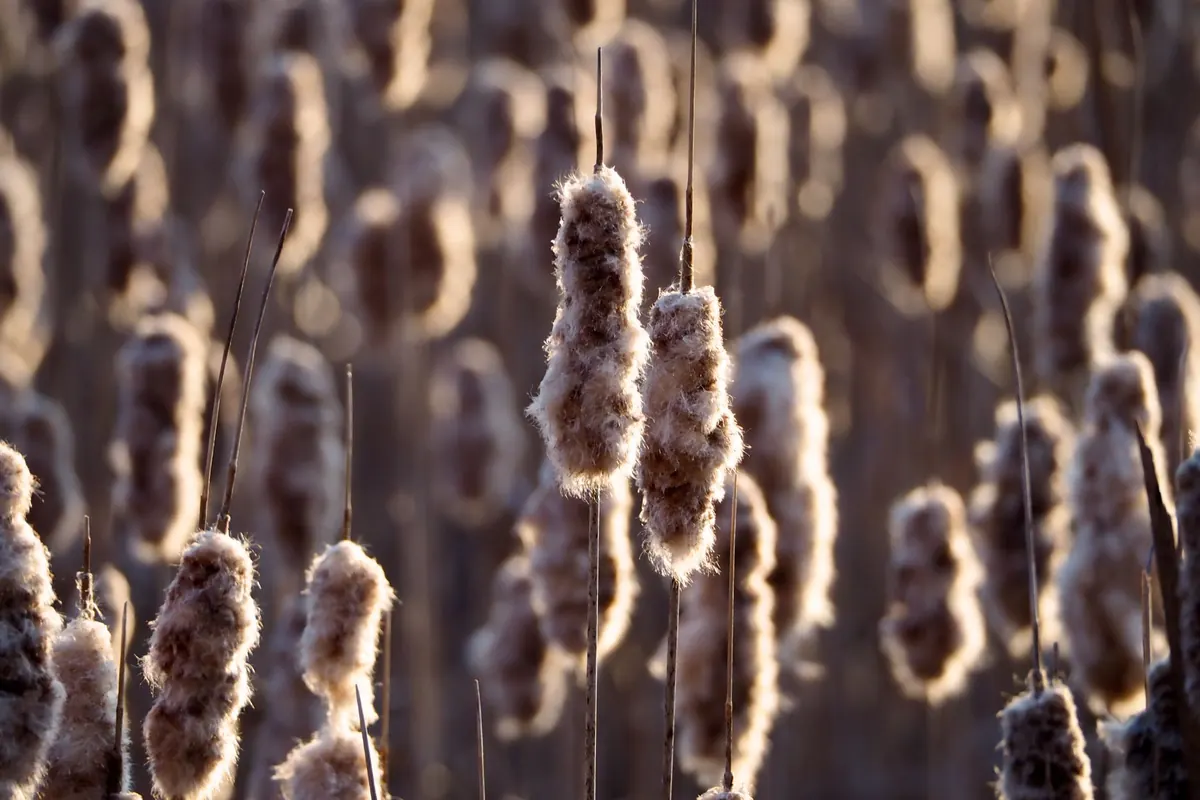
Winter is even more telling. Phragmites holds a tall, pale tan wall of stems that catches low sunlight. Cattails collapse into a softer tangle of broken blades and brown seed fluff.
Stems and Leaves: The Reliable Tests
Cattails
Leaves are flat, strap-like and spongy, usually gray-green to olive, often with a gentle twist. They feel slightly foamy because of the air chambers inside. Run a thumbnail across a leaf and it dents rather than slices. The base of each leaf wraps the stem in a smooth sheath — no hairy collar where blade meets stem. Vegetative growth is mostly sheath and blade; the flowering stalk is round, pithy and jointless.
Phragmites
Stems are stiff, hollow and jointed like bamboo, with visible nodes every 15 to 30 centimeters. They run tan to beige, sometimes with reddish or purple tones; invasive stems generally stay tan through winter. Leaves are long — often 20 to 50 centimeters — and blue-green, arranged in two ranks so they seem lined up on either side of the stem. Peel a leaf back and look at the junction: phragmites has a small membranous flap with hairs called a ligule.
Field rule: if the stem has joints and the leaf grips it with a fuzzy little collar, you are holding phragmites. If the plant is all soft, spongy blades with no joints, it is cattail.
Separating native from invasive phragmites is trickier. Native plants tend to have reddish stems and leaf sheaths that drop off in fall, leaving bare stems, and they often grow mixed with other vegetation rather than as a pure wall. Invasive stands keep their sheaths and their tan color, and they usually dominate completely. If the distinction matters for a management decision, have a botanist or your local extension office confirm it.
Flower Heads Make It Obvious
Cattails produce the familiar brown cylinder — the sausage on a stick — which is the female flower spike, tight and velvety. Male flowers sit above it, shedding yellow pollen before withering. Broadleaf cattail has the male and female portions touching; narrowleaf cattail has a stretch of bare stem between them, a handy clue even though the two hybridize freely.
Phragmites produces a feathery plume at the top of the stem, purplish-brown turning tan, often drooping to one side. It appears in late summer and persists into winter as a pale, wispy tuft. It never looks like a solid cylinder.
Fast Field Checklist
- Stem joints: present and knobby means phragmites; absent means cattail.
- Stem inside: hollow and stiff means phragmites; spongy and pithy means cattail.
- Leaf placement: leaves along the whole stem in two ranks means phragmites; leaves rising from the base only means cattail.
- Leaf color: blue-green suggests phragmites; gray-green or olive suggests cattail.
- Leaf junction: a hairy collar where blade meets stem means phragmites.
- Flower: a feathery, one-sided plume means phragmites; a brown cigar means cattail.
- Winter look: standing tan stems with leaves still attached means invasive phragmites; collapsed blades and fluff means cattail.
- Stand density: a near-monoculture three to five meters tall is typical of invasive phragmites; looser clumps one and a half to three meters tall suggest cattail.
What the Difference Means for Management
If the stand is cattail, the usual answer is to leave it. Cattails are habitat. On a small backyard pond, a patch can be thinned in mid-summer by cutting stems below the waterline, or by adjusting water levels where that is possible. Digging works on small patches but rhizomes travel, so expect regrowth.
Phragmites needs a plan and patience. Cutting alone rarely does more than annoy it, because the rhizome network survives and resprouts. The approach that works is integrated and repeated: an approved herbicide applied at the right growth stage, typically late summer into early fall when the plant is moving energy down into the rhizomes; then mowing or crushing the dead stems; then monitoring and spot-treating regrowth for several years; then replanting with native species to occupy the space. Do not pull or disc the ground — broken rhizome fragments spread and start new stands. Clean boots, tires and equipment before leaving the site, since seed and root fragments travel easily.
Remember the Native Subspecies
In regions where native phragmites occurs, treating a stand that turns out to be the native plant is a real loss. Confirm identification before any control work, especially in high-quality marshes where native phragmites can grow alongside other desirable plants.
Before You Cut, Spray, or Dig
Wetlands are regulated almost everywhere. Check with your state or provincial environmental agency or local conservation authority before doing work in or near a wetland, and expect that herbicide use near water will require an aquatic-labeled product applied by a licensed applicator. Follow the label, and treat permitting questions as a professional matter rather than a guess.
If you are unsure of what you are looking at, gather evidence instead of acting. Photograph the whole stand, a close-up of a stem node, the junction where a leaf meets the stem, and the flower head. Note the location and the date. Your local extension office, land trust or watershed group can usually identify the plant from those four photos. Late summer and early fall are the best times to do this, with flowers and seed heads visible and the plants at their most distinct.
Photo: Alexa Heinrich / Pexels